


You’re measuring more than ever – but is it driving better decisions?
Written by: Jonas Grundström, Sales and Business Development Director at Climber.
About a year ago, I wrote a series of blog posts exploring what it really means to work in a data-driven way. The point was simple: having more data doesn’t automatically make an organisation more data-driven.
It takes much more than collecting data and setting KPIs. We need to build a culture of continuous improvement and experimentation. We need to understand what is actually worth measuring, then make the right data available, and understand how different metrics relate to one another. We also looked at how to analyse deviations and how metric trees can help us make those relationships visible.
But there was one question we never really addressed: how do you turn all of this into a continuous way of working that actually leads to better decisions?
That’s where we pick things up now. And this time, there’s a new factor that’s changing the game significantly: AI.
The gap: ambition vs. decisions
When we build data and analytics solutions with our customers, we keep seeing the same challenge: it’s still difficult to get KPI-driven decision-making to trickle down to every part of the organisation.
All too often, “we’re going to become data-driven” remains an ambition rather than becoming part of how the business actually operates. There may be a handful of strategic metrics being tracked by the management team, but further out in the organisation, the link between data, analysis and the decisions people make is much weaker.
So, we’re collecting more data than ever. Yet when it comes to making decisions, many organisations still fall back on gut feeling.
The problem, in other words, is rarely a lack of data. What’s often missing is a shared foundation and a clear way of working that puts data at the heart of how the business is run.
SO, WHAT DOES IT TAKE?
We believe organisations need a clearer operating model – one that runs through the entire decision-making process, involving far more people than just the management team. That model needs to be built on two foundations: relevant accessible data, and clear ownership.
One way of bringing these elements together is what we call Metric-Driven Decision Making (MDDM).
MDDM IN PRACTICE
MDDM is not a new platform or another tool to add to the technology stack. It is, above all, a way of working.
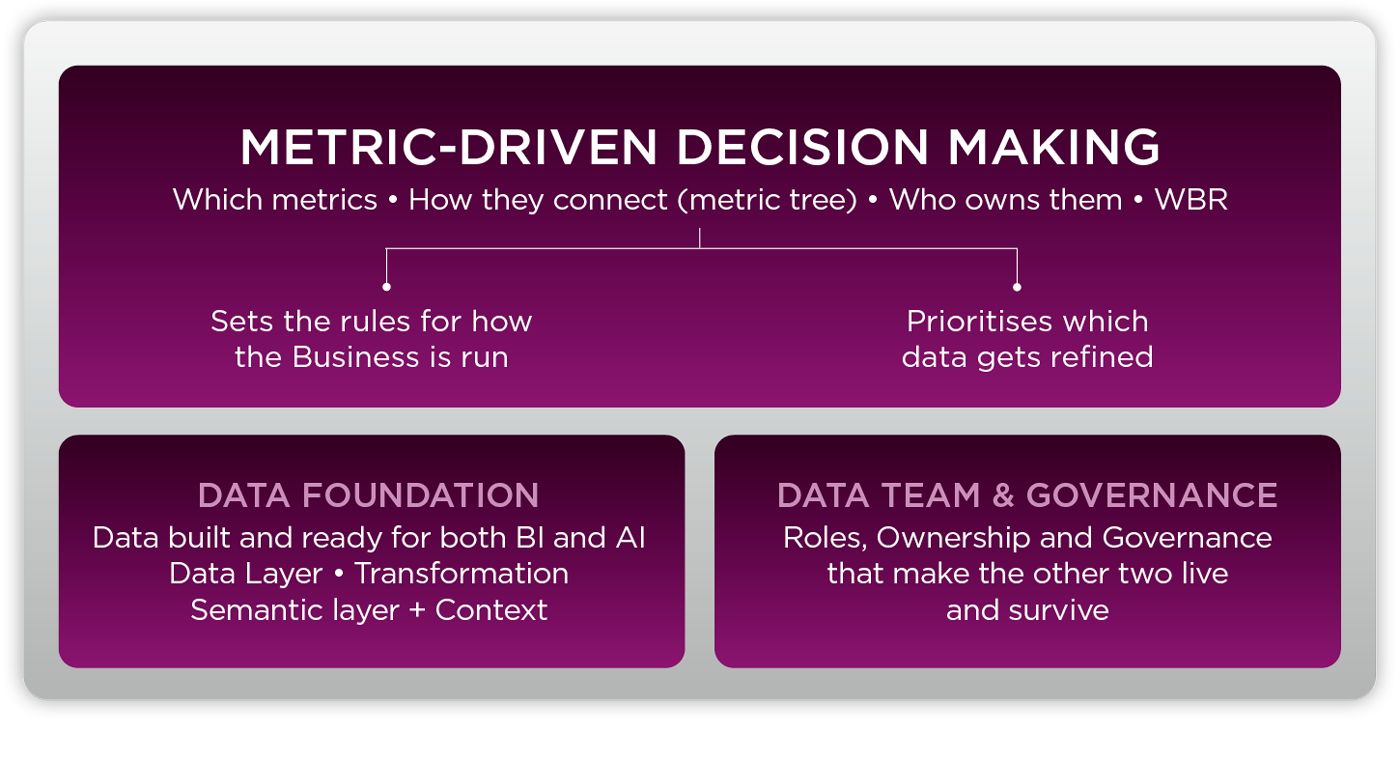
At its core are three things:
- Which metrics we measure – and, just as importantly, which ones we choose not to measure. We start with the business’s most important strategic measures and break them down into operational metrics that individual functions can influence.
- How those metrics are connected – how operational metrics contribute to the strategic measures the business is ultimately trying to improve. We make those relationships visible through a metric tree, or KPI tree.
- How we review the metrics and act on them – through recurring Weekly Business Reviews (WBRs) focused on KPI performance. We analyse and prioritise deviations, assign an owner and agree on the next step. At the same time, we review the metrics themselves and replace them when they no longer help us make better decisions.
This gives MDDM two roles.
First, it establishes the rules for how we run and review the business: what we measure, who owns what, and what we do when something deviates from expectations.
But it also provides something I consider just as important: a prioritisation map for our data.
Once we know which metrics actually drive business performance, we also know which data is worth building, owning and maintaining – and which data we can stop spending time and money on.
SAME PRINCIPLES, NEW POSSIBILITIES WITH AI
The hard truth is that very little of what I’ve described so far is particularly new.
Metric trees, structured business reviews, a shared data foundation and clear ownership are all principles that well-run organisations have been using, in one form or another, for many years.
And the fundamentals still matter. Relevant data needs to be available. Someone needs to own it. Someone needs to develop and improve it. And the organisation needs to actually use it.
What has changed is what’s now possible.
AI is beginning to transform the entire chain: how we build and maintain our data models; how we analyse our metrics and identify the reasons behind deviations; how we prepare for and run our business reviews; and, ultimately, how quickly we can move from “something has happened” to “we understand why – and we know what to do about it.”
AI doesn’t replace the way of working. But it can make a good way of working considerably more powerful – and enable us to scale it across more parts of the organisation.
That is what makes Metric-Driven Decision Making particularly relevant right now.
WHAT’S NEXT?
Over the coming weeks, we’ll explore this in a three-part blog series, taking us from the MDDM way of working all the way to a functioning Enterprise solution.
- First, we’ll look at the core of MDDM: how to choose the right metrics, build the metric tree that makes relationships visible, and review them through a Weekly Business Review. This is what gives us the prioritisation map – a clear view of which data is actually worth building and maintaining.
- Then, we’ll look at how to prepare and build the data foundation, ensuring that our metrics are based on a shared and reliable source of truth.
- Finally, we’ll establish the roles and ownership needed to make MDDM a way of working that lasts – rather than yet another project that eventually falls by the wayside.
Throughout the series, we’ll follow the same thread: how AI is changing what’s possible at every stage, and how it can help more organisations make this approach work in practice.
Until next time, it’s worth asking yourself one simple question:
You’re probably measuring more than ever. But is it actually leading to better decisions – across the organisation?
In the next part, we start building the foundation.
/Jonas

Jonas Grundström
READY TO TURN METRICS INTO ACTION?
Want to explore how you can turn metrics into better decisions?
View our on-demand webinar, Closing the Gap Between Metrics and Decisions.
We take a closer look at how Metric Driven Decision Making can help bridge the gap between what you measure and what you actually do.
Discover how the right metrics, clear ownership, strong business rhythms, and AI can help bridge the gap between insight and action – and turn data into better business decisions.
WANT TO KNOW MORE?
If you’d like to explore how Metric-Driven Decision Making can create value in your organisation, feel free to contact us.
Jonas Grundström
Sales & Business Development Director
jonas.grundstrom@climber.se
+46 73 340 26 36
Samantha Hartley
Marketing & Content Manager
samantha.hartley@climber.se
+46 70 746 75 34
News

From North Star to shelf: Run your inventory with Metrics and AI Agents
Discover how AI agents in inventory management help optimise stock levels, reduce excess inventory & support smarter replenishment decisions. Read the blog by Johan Tullgren here.
Read more
FabCon Europe 2026
Climber recently spent a few days in Barcelona at FabCon Europe 2026, getting properly into what’s next for Microsoft Fabric, Power BI, and the wider Microsoft data and AI ecosystem.
>> Read more
What’s New in Qlik Cloud – October 2026
Qlik Answers gains Fast and Thinking modes for assistants and your AI assistant can now build scheduled and triggered automations. Qlik Data Integration also has a good mix of practical improvements and developments.
>> Read more