

Fabric Apps Change How Organisations Build Data-Driven Applications
Blog by: Gareth Wilson, BI Manager at Climber
A single development experience
When Microsoft Fabric launched, it was positioned as a unified analytics platform. Data Engineering, Data Factory, Data Science, Data Warehousing, Real-Time Intelligence, and Power BI all came together under a single SaaS platform.
With the introduction of Fabric Apps (Preview), Microsoft is taking another significant step. Microsoft Fabric is no longer just becoming a place to analyse data. It is becoming a platform for building complete business applications.
The Challenge Many Organisations Face
Most analytics projects eventually hit the same problem. Reporting tells you what happened. But businesses often need a way to act on that information.
Consider a typical scenario:
- Fabric stores the data
- Power BI reports the insights
- Users identify an issue
- A separate application is used to resolve it
This often means maintaining multiple systems, databases, APIs, and security models. The result is increased complexity, additional costs, and longer delivery times.
Introducing Fabric Apps
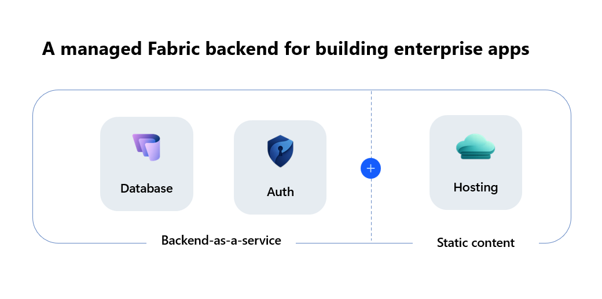
Fabric Apps is a new preview capability that allows developers to build data-driven applications directly within Microsoft Fabric. Rather than having to provision databases, create APIs, configure hosting, and manage authentication separately, Fabric Apps brings these capabilities together into a single development experience.
Microsoft describes Fabric Apps as a platform that combines the following within a unified workflow:
- Data models
- Generated APIs
- Authentication
- Application hosting
This means developers can focus on solving business problems rather than assembling infrastructure.
What Makes Fabric Apps Different?
Traditionally, building a business application requires several moving parts. With Fabric Apps, much of this is automatically generated and managed by Microsoft.
Developers define their data model using TypeScript, and Fabric automatically creates the required database schema and GraphQL APIs. This dramatically reduces the amount of plumbing required to get an application into production.
Real Business Use Cases
Many organisations investing in Fabric are already identifying opportunities beyond reporting.
Examples could include:
Stock Management Portals
A retailer can analyse stock performance within Fabric and provide operational teams with an application to manage stock issues directly.
Approval Workflows
Finance and operations teams can submit, review, and approve requests without moving data between multiple platforms.
AI-Powered Applications
Fabric Apps is also designed to support modern AI scenarios. Applications can leverage the broader Fabric ecosystem, including Data Agents, Fabric IQ, and Microsoft Copilot capabilities as they continue to evolve.
Why This Matters
One of Microsoft Fabric’s greatest strengths has always been simplification. Instead of managing separate data platforms, separate analytics platforms, and separate AI platforms, Microsoft has been bringing capabilities together within a single ecosystem. Fabric Apps extends that philosophy into application development.
For organisations already invested in Fabric, this could mean:
- Faster development cycles
- Reduced infrastructure overhead
- Simpler security management
- Fewer integration points
- Lower operational complexity
Is This a Replacement for Power Apps?
Not entirely. Power Apps remains an excellent platform for citizen developers and rapid low-code solutions. Fabric Apps is aimed more at professional developers who require greater flexibility whilst still benefiting from Microsoft’s managed platform services.
Think of it as adding another tool to the Microsoft application development toolbox rather than replacing existing capabilities.
The Bigger Picture
The Fabric App release demonstrates Microsoft’s longer-term vision for Fabric. Microsoft Fabric is evolving beyond an analytics platform into a broader data, AI, and application platform.
Alongside Fabric Apps, Microsoft continues to invest heavily in:
- Fabric IQ
- Data Agents
- Agentic AI
- Unified governance
- AI-powered development experiences
All of these capabilities are moving towards a future where data, applications, and AI operate within a single managed ecosystem.
Final Thoughts
Fabric Apps may not receive the same attention as Copilot or Agentic AI announcements, but it could become one of the most significant additions to the platform.
Many organisations already use Microsoft Fabric as their analytical foundation. The ability to build operational applications directly on top of that foundation has the potential to reduce complexity, accelerate delivery and bring data closer to business processes.
For organisations investing in Microsoft Fabric, this is a feature well worth watching as it progresses through preview and towards general availability.
SUBSCRIBE
Want to stay up to date with the latest features in Microsoft Fabric and Power BI?
Subscribe to our blog and get monthly updates directly to your inbox.
WANT TO KNOW MORE? CONTACT US!
Victor Runesson
BI Manager
victor.runesson@climber.se
+46 72 050 65 57
Jonas Grundström
Sales & Business Development Director
jonas.grundstrom@climber.se
+46 73 340 26 36
News
What’s New in Qlik Cloud – September 2026
This month brings a new input option for Write Table, improved global search function, smarter data stewardship, and a simpler way to move semantic types between environments.
>> Read more
Qlik Partner Ambassador 2026-2027
Qlik has announced its 2026-2027 Partner Ambassadors! We’re proud to see Olof Malmström recognized for the fifth consecutive year. Read his reflections on the year gone by.
>> Read more here!
Closing the Gap Between Metrics and Decisions
Want to turn metrics into better decisions, actions and measurable outcomes? Join our webinar on Sept 17 to discover how Metrics-Driven Decision Making can help you run a truly data-driven business.
>> Sign up here